
MWLA Best Practice Guidelines for Operating a Boat in Wakeboarding or Wake Surfing Modes
***August 24, 2025 Edit***
The following article was originally posted on June 26, 2023. Since then the public conversation regarding wake surfing has continued, more research has been published and the Town of Manitowish Waters has passed two ordinances. As of this editing date, wake surfing activities are restricted as per the ordinances of June and July of 2025. To understand the ordinances, please access the Town of Manitowish Waters website, Town Code of Ordinance page: https://mwtown.gov/planning-zoning/mw-town-code-ordinances/.
Alternatively, you may wish to review a related article in the summer 2025 MWLA newsletter at: https://mwlakes.com/wp-content/uploads/2025/07/MWLA-Summer-2025.pdf. The original article of 2023 follows this edit note, and helps serve as a history of the process that has unfolded regarding wake surfing.
Thank you.
***************
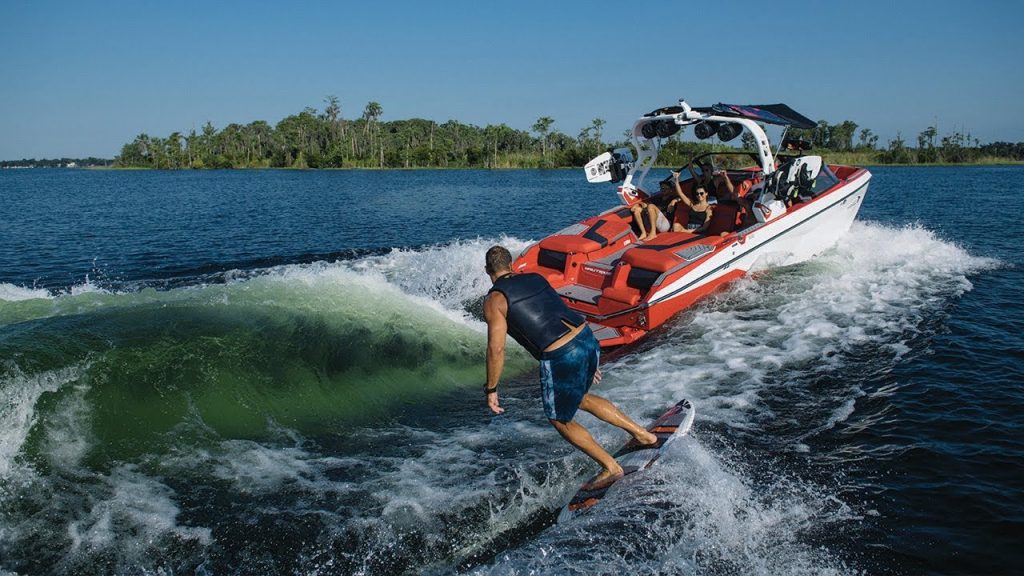
The Manitowish Waters Lakes Association Board of Directors approved the following motion on June 18, 2023 as current best practice guidelines for operating a boat in wakeboarding or wake surfing modes on any lake in the Township of Manitowish Waters. These best practices are not an ordinance or a regulation; they are not enforceable by the Town, the Water Safety Patrol, the DNR, or the County Sheriffs’ Department. These best practice guidelines are meant to be educational.
- Boats operating in wake surfing mode or wakeboarding mode, during which boat speed, wave shapers, and/or ballast are used to enhance wave height, should operate at least 500 feet from docks, the shoreline, or other watercraft.
- Boats operating in wake surfing or wakeboarding modes should operate in water at least 15 feet deep.
- No boat containing ballast from another lake shall enter a Township lake. Prior to arriving at a launch ramp any boat containing ballast tanks should empty all ballast away from the ramp, so that any drained ballast cannot run off into the lake.
– Boat and trailer should be wiped down where ballast is drained, to prevent any foreign lake water from entering the lake while launching.
– If the operator desires to empty ballast when leaving the lake and is on the launch ramp they shall proceed away from ramp prior to emptying their ballast and only then should they empty their ballast so that any drained ballast cannot flow back into the lake.